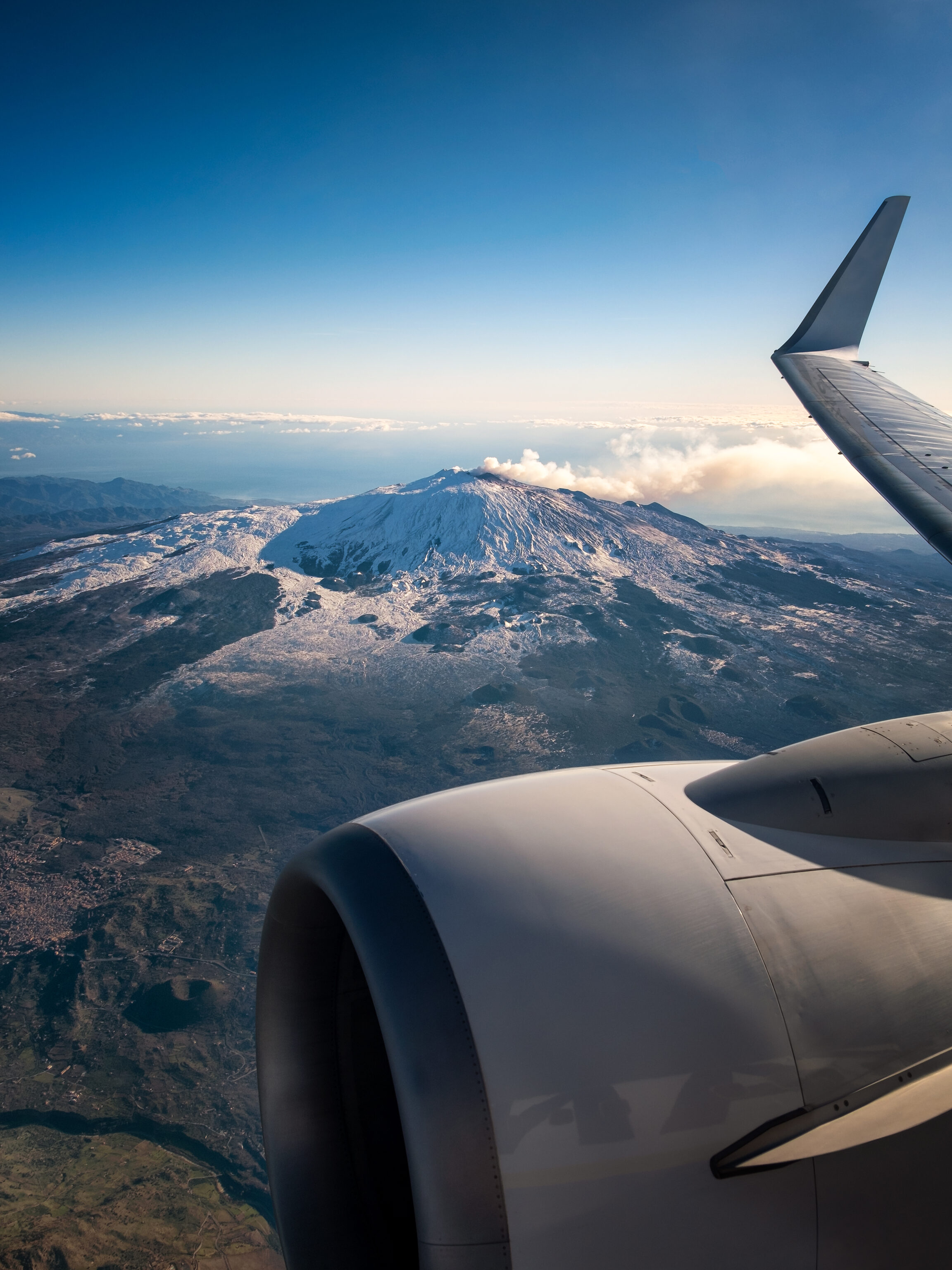
Renewed volcanic activity at Mount Etna has disrupted air travel in Sicily. As a result, Catania Airport (CTA) has had to suspend all arrivals and departures, and several airlines have had to divert or cancel flights.
On September 26, the airport operator, SAC, said that all flight operations at Catania Fontanarossa would be suspended until 12:00 local time on September 27 because of volcanic ash and dangerous wind conditions. Airspace sectors C1 and B3 were also closed as part of the restrictions.
At first, the airport continued to operate with reduced capacity while the ash cloud was approaching. However, the restrictions were later tightened, which led to a complete suspension of both arrivals and departures.
Flights diverted to other Italian airports
The disruption to flights had already begun before the full suspension, as airlines started diverting flights away from Catania Airport. According to Italian media reports, at least 10 flights were diverted: five to Palermo (PMO), three to Trapani (TPS) and two to Comiso (CIY).
Aeroitalia moved its Rome–Catania services to Comiso while Catania Airport remained unavailable. A Delta Air Lines flight from New York to Catania was also diverted to Rome Fiumicino (FCO).
These diversions allowed some services to keep operating, although passengers who were affected had to change their travel plans and, in some cases, needed extra ground transportation.
Other carriers decided to cancel their services instead of diverting them.
KM Malta Airlines confirmed that it had canceled flight KM642 from Malta to Catania and KM643 from Catania to Malta on September 26 because of the volcanic activity and the restrictions that resulted at Catania Airport.
Brussels Airlines also canceled its Catania–Brussels service, which had been scheduled for September 26. The airline said that around 140 passengers had been affected and that they were not expected to return until September 27 or 28. Brussels Airlines also diverted another flight to Palermo, and passengers then continued their journey to Catania by bus.
A TUI fly Belgium service was diverted to Palermo in a similar way.
Etna sends ash plume about 4 kilometers high
The Italian National Institute of Geophysics and Volcanology (INGV) reported that an ash plume had reached approximately 4 kilometers above sea level and that the cloud was moving south. Because of the ongoing ash emission, a red VONA (Volcano Observatory Notice for Aviation) was issued.
Volcanic ash is a serious hazard for aircraft because it can damage engines and other aircraft systems. Therefore, the restrictions at Catania Airport were caused by the presence and movement of the ash cloud, as well as by the airspace limitations that it created.
Whether flight operations will reopen depends on the volcanic ash situation, the wind direction, and the related airspace restrictions. Airlines may also need extra time to reposition aircraft and crews and to restore the schedules that were disrupted by the suspension.