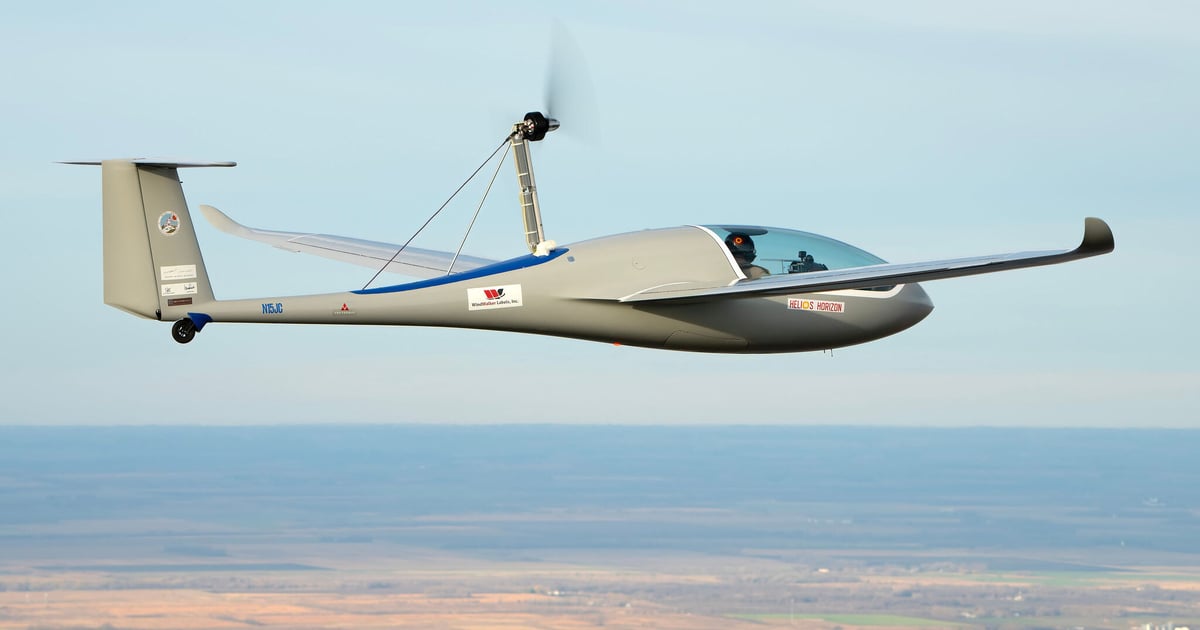
Helios Horizon says its modified electric Pipistrel Taurus broke three world records during a test flight over Grand Forks, North Dakota. According to the group, the aircraft reached 17,200 feet on solid-state batteries. The World Air Sports Federation has yet to ratify the records.
Founder and chief test pilot Miguel Iturmendi flew the aircraft on October 29, with an observer from the National Aeronautic Association present. The nonprofit group says the flight set new records for maximum altitude, altitude in level flight, and time to climb to 3,000 meters in the class of electric airplanes under 500 kilograms. The climb to 3,000 meters took 27 minutes, and Helios Horizon says Iturmendi used only 36 percent of the airplane's battery capacity during the flight.
Iturmendi already holds the class's ratified altitude records. He set both near Minden, Nevada, in 2023, reaching 16,270 feet for maximum altitude and 15,948 feet in level flight. A Helios Horizon spokesperson said the airplane reached 24,000 feet near Bishop, California, in 2024, in a heavier configuration and on lithium-ion batteries. No observer was present to certify that flight.
Those batteries stored 245 watt-hours per kilogram. The solid-state cells store 410 watt-hours per kilogram, which allows the aircraft to fly lighter for the same mission. Solid-state cells replace the flammable liquid electrolyte in conventional batteries with a solid one. That makes the cells less prone to thermal runaway. Helios Horizon has not disclosed the chemistry or the suppliers of its cells.
Iturmendi plans to install batteries with 25 percent greater energy density before attempting 40,000 feet in early 2027. The University of North Dakota's John D. Odegard School of Aerospace Sciences supported the flight tests. Iturmendi also used the school's hypobaric chamber to evaluate a pressure suit and life-support system for flights at higher altitudes.
In the longer term, Iturmendi plans to develop a pressurized airplane called Helios Horizon 2. He says it could carry a pilot and two passengers to 80,000 feet for missions such as high-altitude sensing and stratospheric tourism.