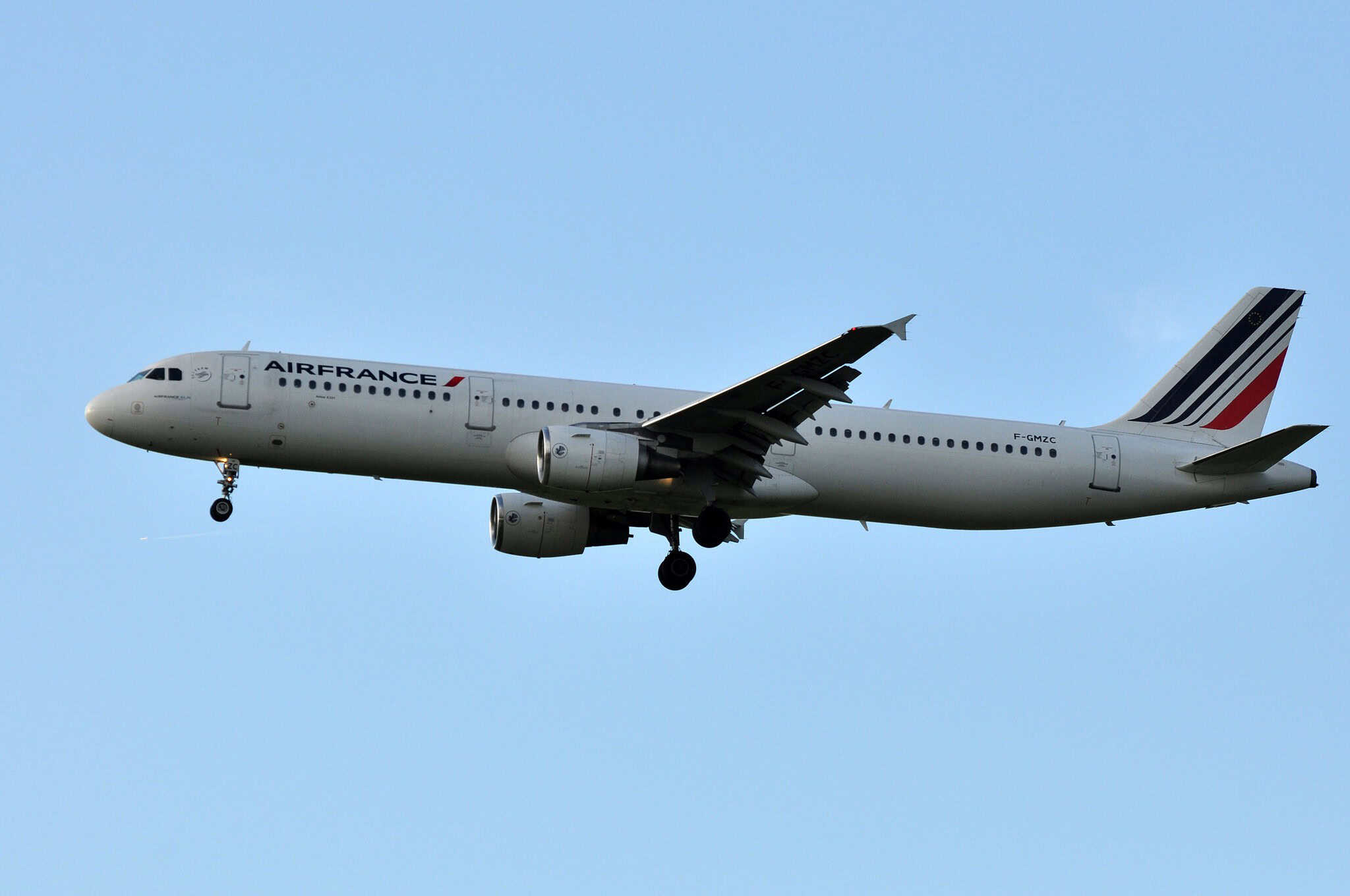
France's BEA has published its final report on Air France flight AF1749, an Airbus A321 registered F-GMZC. On April 27, 2025, the aircraft was descending toward Paris Charles de Gaulle. During the descent, it lost electric control of its horizontal stabilizer. The flight from Malaga landed safely after the crew declared PAN PAN. Nobody on board was hurt.
The most important finding is about what happened after the warning. The pilots misread one checklist line. They trimmed the stabilizer to 3.5 degrees nose-down, only half a degree from its stop. At the same time, the flight computers moved the elevators nose-up to compensate. The crew had no sign of this.
What happened on the descent
On board were 188 passengers, five cabin crew and two pilots. The first officer was flying, and the captain was the pilot monitoring.
The first sign of a problem was an ELAC 2 pitch fault message near FL300. The checklist did not allow a computer reset, and the crew decided to continue to Paris.
Near FL235, several alerts came at once. The autopilot disconnected, and a STABILIZER JAM warning appeared. Automatic trim was lost, and the flight controls changed from normal to alternate law. The first officer flew the aircraft by hand. The captain declared an urgency and asked for a long runway, 08L or 09R.
Passing 3,400 feet, the stabilizer reached 3.5 degrees nose-down. The limit is 4 degrees. The elevators were at 11 degrees nose-up.
The crew set landing flaps first and lowered the gear early. Gear extension switches the controls to direct law, and the crew wanted time to adapt to it. In the flare, the elevators moved from 11 to 19 degrees nose-up. The aircraft landed on runway 08L.
Airbus made simulations for the BEA. At this flight's center of gravity, at least 5 degrees of elevator margin remained. Airbus found no scenario that would have made the flare hard to control.
Why trimming "like direct law" was the wrong move
An A320-family aircraft controls pitch with two elevators and a trimmable horizontal stabilizer. Normally, the flight computers move the stabilizer with electric commands. Pilots can also move it mechanically with trim wheels in the cockpit.
In normal and alternate law, the sidestick asks for a load factor, not a control position. The computers trim the stabilizer automatically. If automatic trim is lost in alternate law, the computers still hold the requested load factor. But now they can do it only by moving the elevators.
Direct law is different. The stick moves the elevators directly, and the pilot trims to reduce the stick input needed. According to the report, this is the only situation in which A320 pilots practice manual trim in the simulator.
The STABILIZER JAM procedure asks the crew to check that manual trim works. Then it says "TRIM FOR NEUTRAL ELEV". The full meaning is only in the detailed manual. The crew should watch the flight control display and use the wheel to keep both elevators near neutral. This way, the elevators keep their full authority.
Instead, the first officer called out a line from the direct law checklist, "USE MAN PITCH TRIM". He trimmed to reduce the stick inputs that he thought he needed. For each nose-down turn of the wheel, the computers gave more nose-up elevator. The BEA notes that the aircraft's handling gave no sign of this.
The captain understood the line as an instruction to set the stabilizer to zero. As the workload increased, he did not monitor the trim closely. Both pilots noticed the unusual trim setting only at the gate.
The BEA lists three contributing factors:
no training in alternate law with manual trim only;
an unclear ECAM item;
incomplete monitoring by the captain.
The report says that training simulators cannot even reproduce this combination. It also says that the lines "MAN PITCH TRIM … USE" and "MAN PITCH TRIM … CHECK" look similar. This made the mix-up more likely.
A misfitted pin, and Airbus's fix
The electric trim stopped working because the computers saw a difference of more than 0.6 degrees between the commanded and the measured stabilizer position. Bench tests of the stabilizer actuator and the ELAC 2 computer found nothing that explains the failure.
Later, Air France and Airbus inspected the aircraft without the BEA. They found an incorrectly installed pin on the first officer's trim wheel. The pin had been on the aircraft since 2019. The BEA says that it may have briefly jammed the mechanical trim linkage. However, the parts were not kept, so this cannot be confirmed.
Air France replaced the actuator and the ELAC 2. The fault has not happened again on F-GMZC.
In August 2025, Airbus sent an operator message about this warning on the A320 family. The message also covered the matching warning on the A330 and A340. In November 2025, Airbus added a detailed STABILIZER JAM procedure to the training manual.