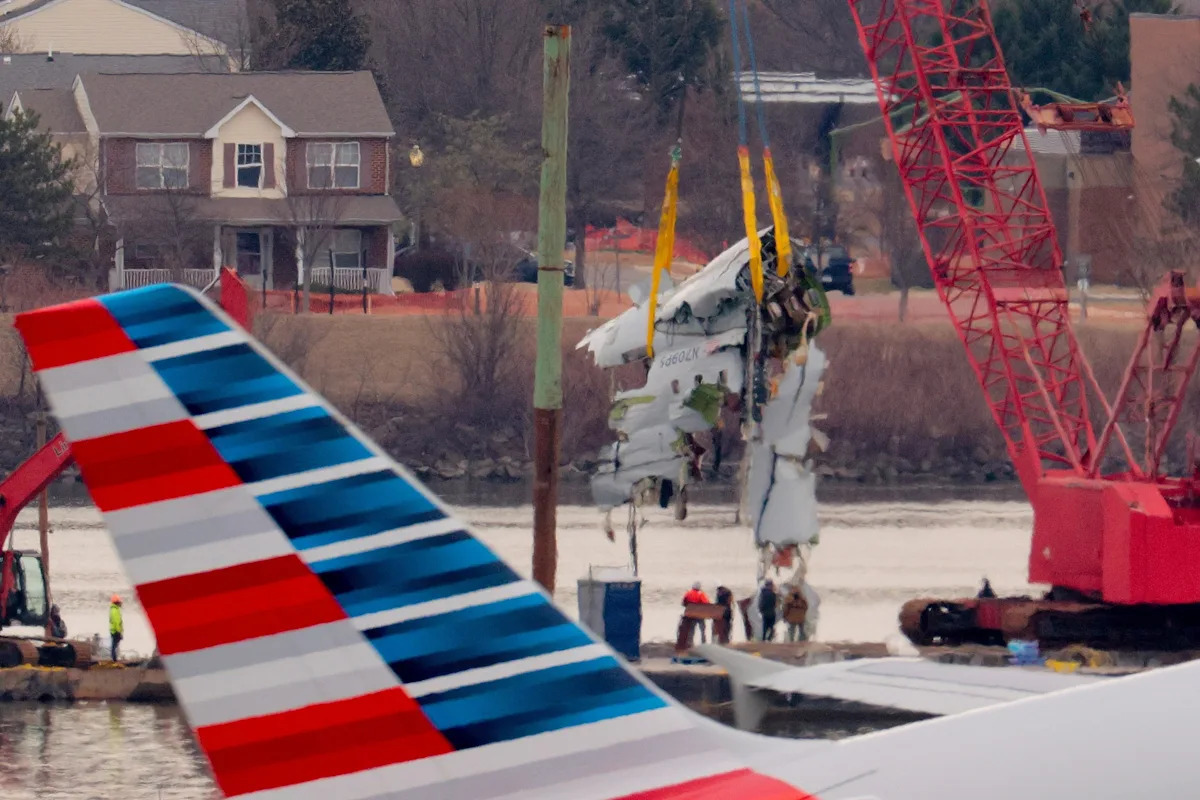
A serious air accident happened near Washington, D.C.
On January 29, 2025, a US Army Black Hawk helicopter and an American Airlines regional jet crashed in the air. The aircraft was a Bombardier CRJ700. It was operated by PSA Airlines.
The accident happened near Ronald Reagan Washington National Airport. There were 64 people on the airplane and 3 people on the helicopter. All 67 people died.
The National Transportation Safety Board, or NTSB, investigated the accident. The NTSB said the accident was not caused by only one mistake. There were long-standing problems in the airspace system.
The investigators found problems with helicopter routes near the airport. Helicopters could fly very close to the flight paths of passenger airplanes. But there were not enough safety measures to prevent a collision.
There was also unclear information about helicopter altitudes and route boundaries. Some helicopter operators could misunderstand the published information. Also, pilots of passenger aircraft could not see helicopter routes clearly on their charts.
The NTSB also said that the FAA did not do enough to reduce the risk of midair collisions near the airport. There had been close encounters between helicopters and airplanes before. But the risk was not reduced in time.
The US Army also had problems in its safety management. It did not have a strong system to monitor helicopter flights near busy airports. Some helicopter altitude problems were not noticed.
The CRJ700 had TCAS, a traffic alert and collision avoidance system. It worked as designed. But because the aircraft were at low altitude, the system could not give a stronger warning with instructions to avoid the collision.
The NTSB said that another system, ADS-B In, could have helped. It could have given the airplane crew more information about the helicopter earlier.
Air traffic control was also a factor. Controllers had a high workload. Helicopters and airplanes used separate radio frequencies. This made communication more difficult.
After the investigation, the NTSB gave many safety recommendations. The recommendations were for the FAA, the US Army, and other organizations.
The NTSB said that changes are needed in helicopter routes, air traffic control procedures, safety management, data sharing, and collision avoidance technology.
The main lesson is clear: serious accidents often happen because of several system problems, not because of one single mistake.