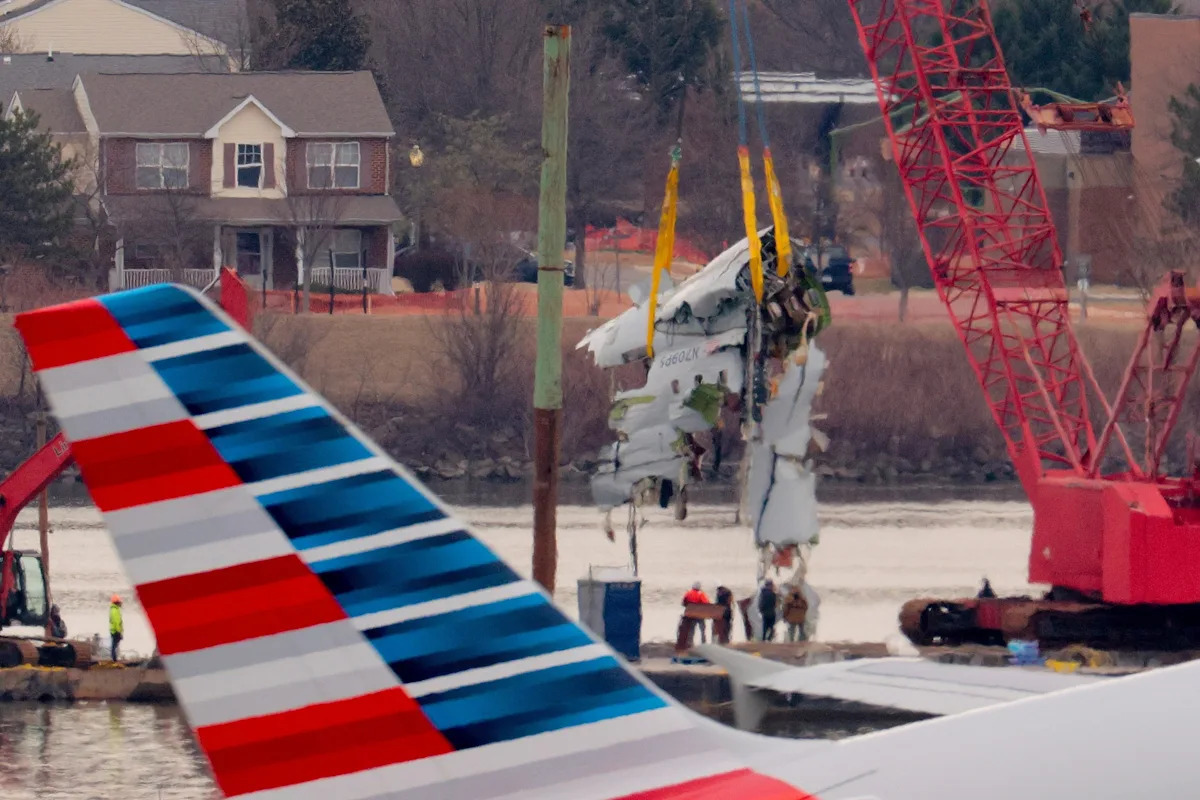
A serious midair collision happened near Washington, D.C., on January 29, 2025.
A US Army Sikorsky UH-60L Black Hawk helicopter and American Airlines flight 5342 collided over the Potomac River. The passenger aircraft was a Bombardier CRJ700 operated by PSA Airlines. The accident happened about half a mile from Ronald Reagan Washington National Airport.
There were 64 people on the airplane and 3 people on the helicopter. Everyone on both aircraft died.
The National Transportation Safety Board, or NTSB, investigated the accident. It said that the crash was not caused by one single mistake. The investigation found several long-standing problems in the airspace system around the airport.
One major problem was the design of helicopter routes. These routes allowed helicopters to fly close to the approach and departure paths of passenger aircraft. According to the NTSB, there was not enough separation between helicopters and fixed-wing aircraft.
The investigation also found problems with altitude information. Some helicopter operators could misunderstand the published altitudes and route boundaries. At the same time, airline pilots did not have clear information about nearby helicopter routes on their charts. This reduced situational awareness.
The NTSB said that the FAA did not do enough to identify and reduce the risk of midair collisions near Reagan National Airport. There had already been close encounters between helicopters and airplanes in this area, but stronger safety actions were not taken in time.
The US Army also had weaknesses in its safety management. The investigation found that the Army did not have an effective system to monitor helicopter flights near busy civilian airports. Because of this, some altitude deviations and close proximity events were not properly recognized as safety risks.
The CRJ700 had TCAS, a traffic alert and collision avoidance system. The system worked as designed. However, because the aircraft were flying at low altitude, TCAS could not give the crew a resolution advisory — a stronger warning with instructions to avoid the collision.
The NTSB also said that ADS-B In technology could have helped. This system could have given the airline crew more information about the helicopter’s position before the collision.
Air traffic control was another factor. Controllers had a high workload during a busy traffic period. Also, helicopters and airliners used separate radio frequencies. This made communication more difficult and increased the risk that important instructions could be missed or blocked.
After the investigation, the NTSB issued many safety recommendations. These recommendations were sent to the FAA, the US Army, and other organizations. They called for changes in helicopter route design, air traffic control procedures, safety management, data sharing, and collision avoidance technology.
The main lesson from the accident is that aviation safety depends on the whole system. A serious accident usually does not happen because of one mistake. It can happen when several risks exist at the same time and are not controlled early enough.