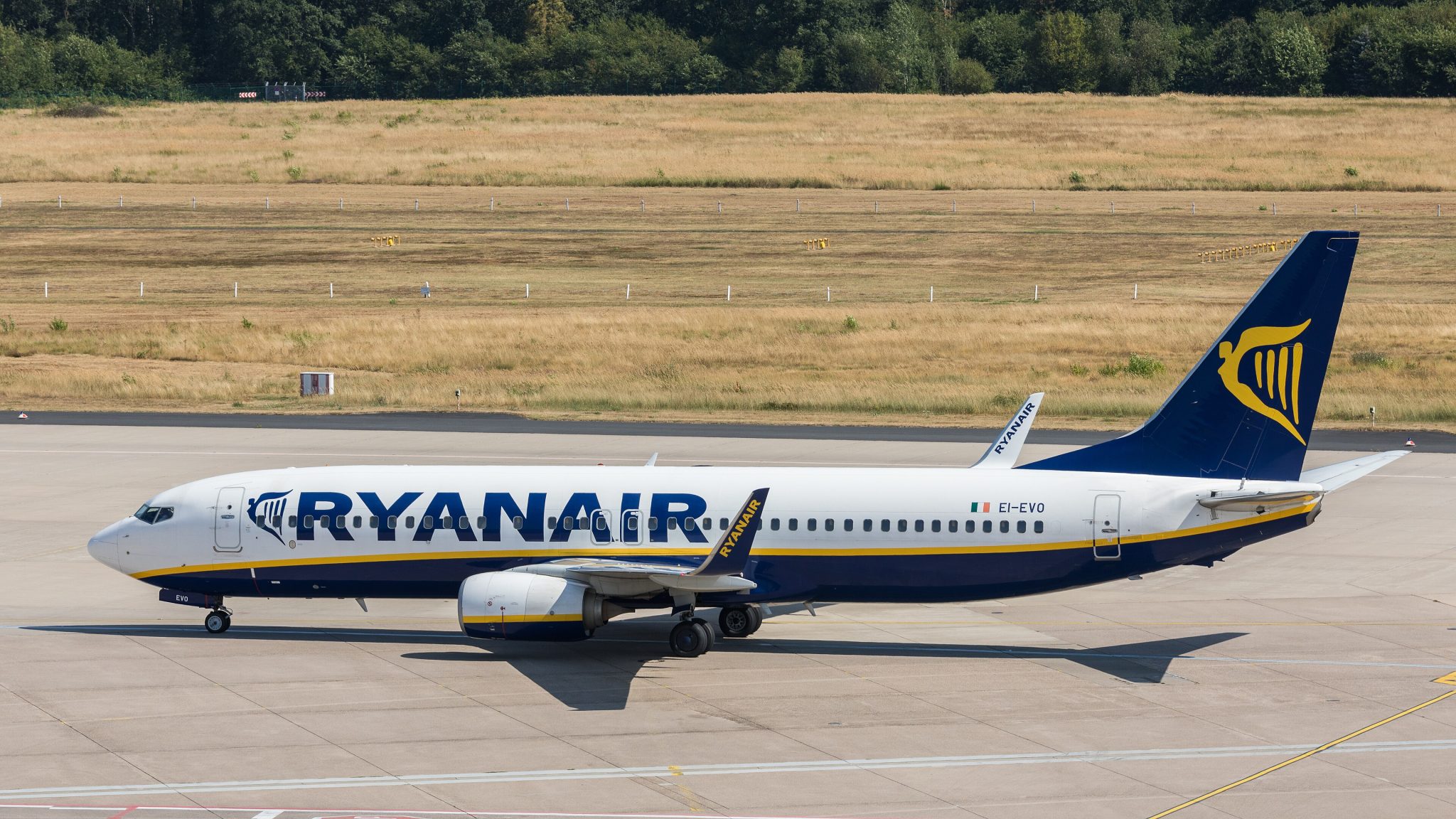
A Ryanair Boeing 737-800 landed at Manchester Airport with just 363 kg of fuel remaining after three windshear warnings, an initial refusal by Manchester to accept the diversion, and a fuel Mayday declaration. The UK Air Accidents Investigation Branch (AAIB) has published a report into the serious incident.
The Malta-registered aircraft, 9H-QBD, was operating a flight from Pisa to Glasgow Prestwick on 3 October 2025. There were 171 passengers and six crew members on board. Storm Amy was affecting Scotland that evening.
After nearly one hour and 45 minutes of flying in difficult conditions, the aircraft touched down with fuel considerably below protected final reserve fuel.
The crew did not ignore the forecast. The operator had issued a storm pack containing four safety bulletins the day before, followed by an additional email on the morning of the flight recommending conservative fuel planning.
Both pilots independently carried out fuel calculations at home and compared them in Pisa. They changed the planned alternate from Glasgow to Manchester, where wind conditions were expected to be more favourable.
The captain also added 1,322 kg of discretionary fuel, equivalent to around 1 hour 12 minutes of extra flight time. Total fuel uplift was 11,500 kg.
However, there was a limitation: due to the crosswind at Prestwick, the longer Runway 30 could not be used. The flight therefore had to plan for landing on the shorter Runway 20. This restricted the allowable landing mass and, consequently, the amount of additional fuel that could be carried.
The flight departed Pisa more than an hour late, at 15:28 UTC. During the first approach to Prestwick, the surface wind was 240°/29 kt, gusting to 45 kt.
At approximately 264 ft, a windshear warning activated and the captain carried out a windshear escape manoeuvre.
The aircraft then held near Turnberry while the crew monitored another Ryanair Boeing 737 approaching Prestwick. That crew reported a 25 kt loss of airspeed at 500 ft on short final, but landed successfully. The crew of 9H-QBD therefore decided to attempt a second approach.
Before the second attempt, they clearly advised ATC:
“In the event of another go-around, we will proceed directly to Manchester.”
On the second approach, the windshear warning activated at only 50 ft.
The operator’s procedures prohibited a third approach after two windshear-related go-arounds. The logical next action was to divert to Manchester.
Moments later, ATC informed the crew that Manchester could not accept them.
No explanation was given at the time.
The AAIB found that this refusal should not have occurred. Under Manchester’s policy for diversion flights, the airport accepts diversions when ground capacity exists. The decision should be made by Airfield Operations, not by the handling agent.
The Excess Parking Plan had not been activated, and Manchester had already accepted 19 diversion flights due to Storm Amy that day.
Nevertheless, at 18:34 UTC, Airfield Control told ATC that the handling agent could not accommodate the aircraft. The handling agent itself later stated that its policy was to accept diversion flights for this operator.
Because there was no recording of the conversation, investigators could not determine exactly how the decision was made. They identified a breakdown in communication within Manchester Airport as the cause.
With Manchester unavailable and Glasgow also reporting windshear on final approach, the crew requested Edinburgh.
Arranging that diversion took another five minutes. During that period, the pilots discussed declaring Mayday, because doing so would have guaranteed acceptance at Manchester. However, they decided their fuel state had not yet met the FCOM/Operations Manual criteria for an emergency declaration.
The operator later noted that, if the crew had genuinely doubted their ability to land safely at Edinburgh, an emergency declaration could still have been justified.
At Edinburgh, the wind was 240°/34 kt, gusting to 46 kt. At 745 ft, the third windshear warning of the evening activated. The crew performed another windshear escape manoeuvre, leaving 2,164 kg of fuel.
The crew now faced a difficult decision.
A further attempt at Edinburgh would preserve final reserve fuel only if the landing was successful. If it failed, there would be insufficient fuel to divert elsewhere, potentially forcing the crew to continue an approach despite an active windshear warning.
With 2,100 kg remaining, an estimated 2,800 kg was needed to reach Manchester while preserving reserve fuel. The crew initially estimated landing with 500–700 kg. Once the route was entered into the FMC, the predicted landing fuel was only 300 kg.
At 19:12 UTC, the captain declared:
“Mayday, Mayday, Mayday, fuel”
and requested immediate diversion to Manchester, reminding ATC that the airport had previously refused the aircraft.
During the climb to FL230 and the southbound flight, both main fuel tanks generated low-fuel indications. The crew also corrected a 100 kg fuel imbalance.
They did not carry out the Low Fuel Quantity checklist because the reason for the indications was known.
Notably, Newcastle was not considered, despite being closer and reporting a 22 kt wind. Edinburgh, already behind the aircraft, was also nearer than Manchester. The AAIB suggested that the initial preference for Manchester may have influenced the crew’s thinking and narrowed the range of alternatives considered later.
The aircraft landed on Runway 23R at Manchester at 19:52 UTC with 363 kg remaining. After engine shutdown at the stand, the FDR recorded only 240 kg of fuel.
At go-around thrust, the engines were consuming approximately 120 kg per minute. Therefore, another go-around at Manchester would almost certainly no longer have been a viable option.
Final reserve fuel for the flight was 1,101 kg, equivalent to approximately 30 minutes of flight. This is the fuel intended for unforeseen circumstances.
The operator’s procedures permit the use of final reserve fuel in an unforeseen situation, but require crews to first seek a landing option that preserves that reserve.
The AAIB accepted that the captain considered Manchester the safest available option, even though it guaranteed landing below final reserve fuel. The EGPWS manufacturer confirmed that all three windshear warnings were valid and that the system functioned correctly.
According to the investigation, the most serious systemic failure occurred on the ground. Had Manchester accepted the initial diversion request, the aircraft would probably have landed with a normal fuel reserve.
Following the incident, Manchester Airport reaffirmed that only Airfield Control may decide whether to accept diversion flights. Handling agents should only be informed; they should not be involved in the decision.
- Listing an alternate aerodrome in the flight plan does not guarantee that it will be able—or willing—to accept the flight. An alternate may not even receive the flight plan.
- Crews need clear, early triggers for declaring an emergency rather than waiting until fuel calculations leave no practical alternatives.
- After multiple windshear escape manoeuvres, crews should deliberately reassess all available aerodromes rather than fixating on the originally preferred alternate.
- When an arrival below final reserve fuel is expected, the issue is no longer merely fuel economy; it is about securing a safe, guaranteed landing.
All 177 people on board landed safely in Manchester, but with far less safety margin than the aviation system should normally permit.